
Mastering the Elevator Pitch
Tips and templates that will help you craft the perfect elevator pitch

Hi!
My name is Tomer and welcome back to TJ’s Innovation Zone.
My passion is to connect people and technology.
For more than a decade I’ve been working with startups, government, and large corporations, helping to promote innovation in conservative industries.
In this newsletter, I share my experience and discuss innovation, business development, and strategies for startups.
Let’s start...
Earlier this week, I had the privilege of attending an Investors Day event, marking the culmination of an accelerator program where I served as a mentor.
These events are always exciting for me.
As a guest, you get to hear innovative ideas and meet passionate entrepreneurs.
As a mentor, you witness the impact of the program firsthand.
Unfortunately, my mentees had to skip the event due to a business trip to Europe. However, I had the opportunity to witness a group of promising entrepreneurs, the program's graduates, stand before a panel of investors, their relatives, and dozens of attendees, and deliver their one-minute elevator pitch.
That was their task for the day.
If you've been in a similar situation, you know it's not an easy task…
Especially for first-timers.
Despite their hard work and preparation, many struggled to present a clear and concise pitch that would intrigue investors to learn more.
Aside from the pressure of pitching to investors (a skill they'll need to master), the most common mistake first-time founders make is treating an elevator pitch as a condensed version of a pitch deck.
This fundamental mistake often results in a confusing message that exceeds the one-minute framework and lacks clarity. More on that later on.
Inspired by this week's event, I've compiled a guide to help entrepreneurs perfect their elevator pitches, ensuring they can seize every opportunity to impress potential investors and partners.
I’m sure you’ll find it practical and useful.
If you do, don’t forget to like and share this post.

Mastering the One-Minute Elevator Pitch
The world around us is moving faster than ever before (metaphorically of course).
Attention spans are shrinking, and people are losing interest quickly.
As an early-stage startup founder, you often have a brief window to make a lasting impression and outshine in a saturated ecosystem of startups and innovative ideas.
This is where the one-minute elevator pitch shines.
Whether at a networking event, in an elevator with a potential investor, or during a demo day, being able to convey your idea succinctly is crucial.
In this blog post, I will guide you through understanding the goals of an elevator pitch, its use, and what are the challenges most people face crafting a pitch and executing it.
Plus, I added two templates to help you craft your first elevator pitch draft.
But first...
What is an Elevator Pitch?
An elevator pitch is a brief, persuasive speech that sparks interest in what your startup does. It should last no longer than a short elevator ride, typically 30 seconds to one minute. The goal is to convey your key message clearly and quickly, whether attracting investors, finding clients, or raising brand recognition.
When Do We Need an Elevator Pitch?
Elevator pitches are versatile and can be used in various scenarios:
Networking Events: Introduce your business to potential partners or clients.
Investor Meetings: Capture the interest of potential investors quickly.
Sales Calls: Quickly explain the value of your product or service.
Random Encounters: Capitalize on serendipitous opportunities.
You need an elevator pitch for situations where you're not given an opportunity to present your startup formally but still want to seize the moment and secure a follow-up call at a more suitable time.
The Challenges of Crafting a One-Minute Pitch
Crafting and memorizing a one-minute pitch may seem like an easy task, but it's far from the truth. Describing something you're familiar with, like your family or favorite book, would be a breeze.
However, when you have a specific goal or stake in mind, the challenge escalates.
Now you must carefully weigh every word and consider how to phrase your message in a way that achieves your desired outcome.
The difference is akin to describing your Tesla versus selling it at a car show full of similar vehicles.
In the first scenario, you’d probably find yourself trying to come up with enough words to fill the one-minute time frame. In the latter scenario, you'd find yourself sorting through superlatives to find the RIGHT words that craft the most compelling pitch.
That’s a whole different story.
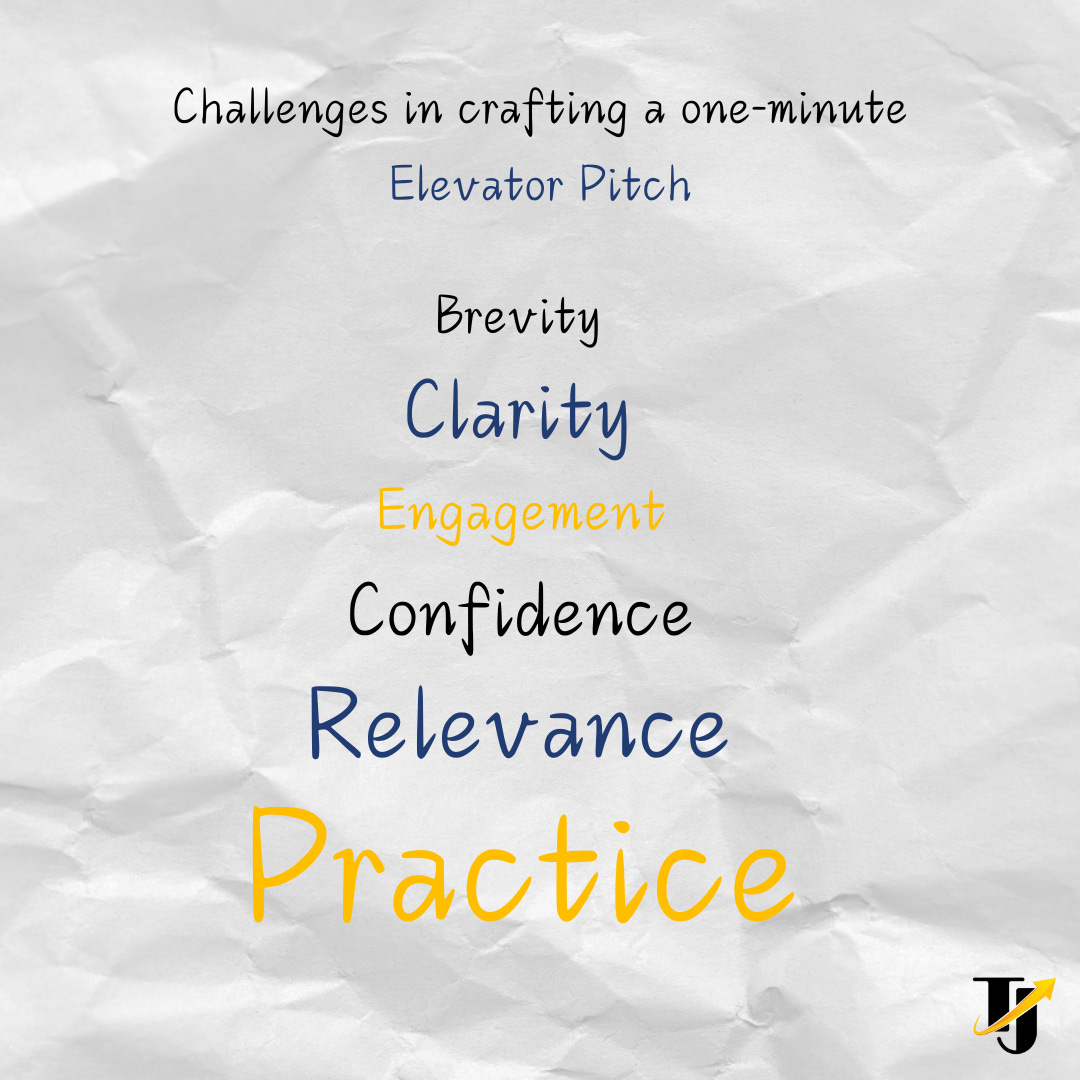
Here are the main challenges of crafting a perfect pitch:
Condensing your message into a short timeframe while retaining its essence.
Avoiding jargon and complex terms that can confuse your audience.
Capturing and maintaining your listener's interest.
Delivering your pitch with conviction and enthusiasm.
Tailoring your pitch to suit different audiences and contexts.
Ensuring you're well-prepared to deliver your pitch smoothly.
Or, in short:
Now that you understand the challenges, I want to share with you six tips that will help you craft your startup’s elevator pitch
Six Tips for a Winning Elevator Pitch
Start with a Hook
Begin with a compelling hook that grabs your audience’s attention. This could be a surprising fact, a question, or a bold statement.
Ensure your hook is relevant to the situation or the person you are pitching to.
For example, “Did you know that 73% of all teams will have remote workers by 2028?”Keep it Simple and Clear
Use simple language that anyone can understand.
Avoid industry jargon and complicated terms. Aim for clarity and precision.
The goal is to make your pitch easily digestible for everyone, from your grandmother to a top investor.
Highlight the Problem and Solution
Clearly state the problem your product or service addresses and how it provides a solution. This helps your audience understand the value you offer.
For example, “Our app solves the problem of remote team communication by providing a seamless, all-in-one platform.”Show Your Value Proposition
Explain what makes your product or service unique and valuable. This is your chance to differentiate yourself from competitors.
For example, “Unlike other platforms, our app integrates project management, communication, and file sharing in one easy-to-use interface.”
Include Traction and Market Size
Mention any significant achievements or milestones you’ve reached.
This could be user numbers, revenue, or notable partnerships. Also, briefly touch on the market size to show the potential.
For example, “We’ve already onboarded 10,000 users and are tapping into a $20 billion market.”
End with a Strong Closing Statement
Conclude by thanking your audience and reinforcing your main message.
If appropriate, mention if you’re looking for investment or partnerships.
For example, “Thank you for your time. We’re XYZ Company, and we’re currently seeking investors to help us scale. Let’s connect!”
Here are two templates that will help you frame it into a compelling message.
Startup Pitch Template
Hook: “Did you know that [CUSTOMER CATEGORY] experience [MASSIVE PAIN]?”
Problem: “This is a [MARKET SIZE] billion-dollar opportunity in [LOCATION] alone.”
Solution: “[PRODUCT NAME] is a [PRODUCT CATEGORY] that [VALUE PROPOSITION].”
Differentiator: “Unlike other alternatives, we [KEY DIFFERENTIATOR].”
Team: “Our team includes [CREDIBLE TEAM BIOS].”
Business Model: “We make money by [BUSINESS MODEL].”
Closing: “In essence, we are the [WELL-KNOWN ANALOGUE] for [ANALOGUE PRODUCT CATEGORY], and our vision is to [HOW THE WORLD WILL BE DIFFERENT]. We have already [EXECUTED MILESTONES], and you must be involved because [INVITE!].”
Example:
“Did you know that small businesses lose over $100 billion annually due to inefficient project management?
This is a $50 billion opportunity in the US alone. TaskMaster is a project management app that integrates task tracking, communication, and file sharing in one platform.
Unlike other tools, we offer a unique AI-driven task prioritization feature. Our team includes former Google engineers and a Harvard MBA. We generate revenue through monthly subscriptions.
Essentially, we are the Slack for project management, and our vision is to streamline small business operations.
We’ve already onboarded 10,000 users and are seeking investment to scale. Let’s connect!”
Investor Pitch Template
Introduction: “At [COMPANY NAME], we [BUSINESS CONCEPT OFFER], plain and simple.”
Value Proposition: “We [VALUE PROPOSITION].”
Supporting Evidence: “Our portfolio contains [SUPPORTING EVIDENCE].”
Differentiator: “Why us? Well, we [DIFFERENTIATOR].”
Engagement: “We roll up our sleeves and get involved.”
Closing: “We’re currently prospecting [TARGET AUDIENCE] to join us on our journey. If you’re ready to be part of the next [FIELD] disruption, let’s talk about how [COMPANY NAME] can help.”
Example:
“Did you know that 60% of small businesses struggle with financial management due to inadequate tools?
At FinTech Innovations, we simplify financial management for small businesses.
We offer a comprehensive suite of tools that handle invoicing, expense tracking, and financial reporting. Our portfolio includes over 500 satisfied clients, with an average revenue growth of 30% per year.
Why us? We integrate seamlessly with existing accounting software and offer unparalleled customer support.
We roll up our sleeves and get involved with our clients’ success.
We’re currently seeking investors to help us expand our reach. If you’re ready to be part of the next fintech disruption, let’s talk about how FinTech Innovations can help.”
Summary
Crafting a perfect one-minute elevator pitch is both an art and a science.
By following the guidelines and tips provided, you can create a pitch that is clear, engaging, and effective.
Remember, the goals of an elevator pitch differ from a sales pitch or pitch deck presentation.
With an elevator pitch, your sole aim is to pique the listener's interest enough to secure a few more minutes to deliver your sales pitch or schedule a follow-up meeting to present your pitch deck.
That's it – just a few more minutes.
Practice your elevator pitch regularly and refine it based on feedback.
A well-crafted elevator pitch can open doors to new opportunities and help you make a memorable impression on potential investors, partners, or clients.
Don't let this chance slip by. Craft your elevator pitch today and be prepared to seize every opportunity that comes your way.
If this blog post helps you take the first steps, make sure to subscribe so you won’t miss tips and insights that I share here weekly, on TJ’s Innovation Zone
Interesting News and Articles
Real Estate tech firm secures $34M in series B funding
Rivian’s path to survival is now remarkably clear
AI image misinformation has surged
YouTube and Podcasts
Apple’s AI WWDC approaches, Nvidia's $3T valuation and more
GPT-4o Changed Data Analysis Forever... (Full Guide)
This week’s LinkedIn posts
AI in warfare - China and Taiwan’s innovation war
It’s a plane, it’s a bird…no it’s Walmart - On drone deliveries